Compact vs Full-Size Microwave: The Honest Size Guide for Home Cooks
Compact microwaves (typically 0.5-1.2 cu ft, 600-1100 watts) work well for reheating, defrosting, and simple cooking in tight kitchens, dorm rooms, or offices. Full-size models (1.5-2.2 cu ft, 1200-1600 watts) heat faster, fit larger dishes, and handle more demanding tasks like cooking a whole chicken or steaming a big bowl of soup. If your kitchen has room and you regularly cook from scratch, the extra capacity earns its place.

What "Compact" and "Full-Size" Actually Mean in Specs
The industry uses capacity in cubic feet as the dividing line. Compact microwaves generally run 0.5 to 1.2 cu ft with wattage between 600 and 1100 W. Full-size countertop units start around 1.5 cu ft and reach 2.2 cu ft at 1200 to 1600 W. Wattage is the more practical spec: a 700 W compact takes roughly twice as long to heat the same portion as a 1400 W full-size unit. Power levels matter too, a compact with 10 or 11 power levels gives you finer control than one with only 5, which helps avoid rubbery edges on leftovers.
Counter Space and Kitchen Layout
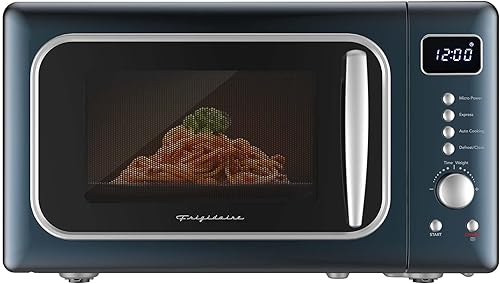
Compact models shine where inches count. The Frigidaire EMW788BLUARGENT, for example, measures just 13.27 x 18.9 x 11.52 inches and weighs 14.5 lb, so it fits comfortably on a narrow galley counter or slides onto a small shelf. A full-size microwave can be 6-8 inches taller and several inches deeper, requiring a dedicated spot that may crowd adjacent appliances. If you live in an apartment, an RV, or a studio, a compact unit often makes the only practical sense regardless of cooking style. Renters who move frequently also appreciate the lighter weight and easier packing.
Capacity: What Actually Fits Inside
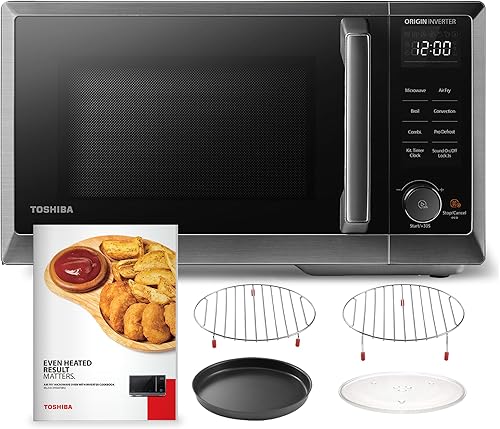
The turntable diameter is the real-world test for capacity. A compact with a 9.6-inch turntable, like the Toshiba MM-EM07PA, accommodates a standard dinner plate and a mug side by side, but a 9x13 casserole dish will not clear the walls. Full-size microwaves typically run 12-15 inch turntables, enough for a large dinner plate, a covered casserole, or a family-size bowl. If you regularly reheat leftovers in the container they were stored in, or defrost a full chicken breast flat, a full-size gives you room to work without rearranging food. Compact capacity is enough for single-serve portions and cups or mugs.
Cooking Versatility: Convection and Power Levels
Some compact microwaves include convection heating, which circulates hot air to brown and crisp food the way a small oven would. The Toshiba ML2-EC09SAIT(BS) is a 0.9 cu ft compact with convection at 1800 W and 10 power levels, an unusual combination that gives it genuinely oven-like capability despite its footprint. The Magic Chef MCM1611W pushes to 1.6 cu ft with convection at 1100 W and 11 power levels, landing closer to full-size territory in both cooking range and interior room, with a 13.58-inch turntable. If baking, roasting, or crisping leftovers matters to you, look for convection in whichever size you choose, not just the wattage number.
Price and Value at Each Size
Compact microwaves are almost always cheaper to buy and run. Entry-level compacts start well under $100 and basic models like the Frigidaire EMW788BLUARGENT land at $79.99, making them easy to replace if they break rather than repair. Full-size countertop units typically start around $130 and rise steeply if you add convection, inverter technology, or smart features. Running costs are minimal for either size, microwave ovens are already among the most efficient kitchen appliances, but a 1600 W full-size does draw more electricity per minute than a 700 W compact. For occasional reheating, that difference is negligible; for daily heavy use, a compact saves a little over time.
Who Should Buy Each Size
Choose a compact if you live alone or with one other person, your kitchen counter is limited, you mostly reheat leftovers and defrost, or you want a secondary microwave for a bar, office, or basement. Choose a full-size if you cook for a family of three or more, you frequently use microwave-safe casseroles or large containers, you want higher wattage for faster cooking, or a built-in or over-the-range installation is planned. Neither size is universally better, the right choice depends entirely on how much food you heat at once and how much counter real estate you can spare.
Common mistakes to avoid
- Judging capacity by cubic feet alone instead of checking the turntable diameter against your largest dish
- Ignoring wattage, then being surprised that a 700 W compact takes twice as long as a 1400 W full-size
- Buying a compact to save space without measuring actual counter depth and overhead clearance first
- Assuming a convection feature is only found on full-size units, compacts like the Toshiba ML2-EC09SAIT(BS) include it
- Overlooking power levels: a compact with only 5 levels gives you less cooking control than one with 10 or 11
- Choosing a full-size microwave for a tight kitchen because it ‘has more features,’ then losing all usable prep space
Frequently asked questions
What cubic footage counts as compact for a microwave?
Most manufacturers and retailers treat anything under 1.2 cu ft as compact. The smallest countertop models start around 0.5-0.6 cu ft, while the upper end of compact sits at 0.9-1.0 cu ft. Once you hit 1.5 cu ft you are firmly in full-size territory, though some brands label 1.1-1.3 cu ft units as ‘mid-size.’
Does a compact microwave cook food more slowly?
Yes, in most cases. Lower wattage, typically 600 to 1100 W in a compact versus 1200 to 1600 W in a full-size, means longer cook and reheat times. The Frigidaire EMW788BLUARGENT, for instance, runs at 700 W, which takes roughly twice as long to bring a bowl of soup to temperature as a 1400 W full-size unit. If speed is a priority, look for a compact with higher wattage like the 1800 W Toshiba ML2-EC09SAIT(BS).
Can a compact microwave replace a full-size for a family?
For a family of three or more who regularly reheats full meals or cooks from scratch, a compact will feel limiting. The smaller turntable means you heat things in batches, and lower wattage adds minutes to every use. A compact works well as a household’s primary microwave only if cooking tasks are light, beverages, single-serve portions, occasional defrosting.
Is a compact microwave good for a small apartment?
It is usually the best choice. Compact models weigh as little as 14-22 lb and measure under 14 inches tall, so they fit on cramped counters, in cabinets, or on top of a mini-fridge. The cooking limitations are rarely a problem for one or two people doing everyday reheating. Models like the Frigidaire EMW788BLUARGENT at $79.99 keep the investment low if the space situation changes.
What is the difference between a compact microwave and an over-the-range microwave?
An over-the-range (OTR) microwave mounts above your range, doubles as a range hood with ducted or ductless ventilation, and typically has 1.5-2.1 cu ft capacity, putting it solidly in full-size territory. Compact countertop microwaves sit on a flat surface, need no installation beyond a 120 V outlet, and are much easier to move or replace. OTR units require cabinetry clearance, a proper venting path, and professional installation in many cases.