Ducted vs Ductless Range Hood: Which One Actually Clears Your Kitchen Air?
A ducted range hood pulls cooking smoke, steam, and grease-laden air out of your kitchen through a duct that exits the house. A ductless (recirculating) range hood pulls that same air through a charcoal filter to trap odors, then blows the cleaned air back into the room. Ducted ventilation is more effective at removing heat and moisture; ductless is the practical choice when exterior venting is impossible, such as in many apartments or island kitchens where running a duct is too costly.

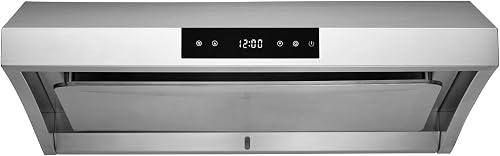

How a Ducted Range Hood Works
A ducted hood, sometimes called a vented or exhaust hood, uses a fan to draw air up through metal grease filters, then push it out through a duct that runs to an exterior wall or through the roof. Because the air physically leaves the building, ducted systems handle high-heat cooking over gas burners and heavy frying far better than any recirculating alternative. CFM (cubic feet per minute) is the key spec: a 30-inch hood over a standard gas range generally needs at least 400 CFM, while high-output gas burners or commercial-style ranges can demand 600 CFM or more. The Hauslane UC-PS38 is a ducted under-cabinet model rated at 950 CFM with stainless baffle filters, strong enough for serious home cooking. Baffle filters on ducted hoods are the preferred filter type because they catch grease efficiently and go straight in the dishwasher, making maintenance straightforward.
How a Ductless Range Hood Works
A ductless or recirculating hood draws air through a mesh or aluminum grease filter first to catch large grease particles, then passes the air through one or more activated charcoal (carbon) filters that adsorb odors and some smoke particles before returning the air to the kitchen. The Broan-NuTone 413001 is a classic example: it mounts under a cabinet, uses a charcoal filter, runs on two fan speeds, and costs around $89, making it one of the most popular ductless hoods on the market with over 20,000 buyer ratings and a 4.6-star score. The critical maintenance point with any ductless hood is that charcoal filters cannot be cleaned; they must be replaced every three to six months depending on how often you cook. Skip that step and the filter stops absorbing odors entirely, leaving you with a fan that moves air but does nothing useful about smells or grease.
Ventilation Performance: What the Numbers Tell You
CFM airflow is where ducted hoods have a clear structural advantage. Because the air exits the house, there is no ceiling on how powerful a ducted fan can be, you simply size it to your cooking load. Ductless hoods face a harder physics problem: they must clean and return the same air repeatedly, so charcoal filters become saturated faster under heavy use and heat is never actually removed from the room. Noise (measured in sones) also scales with CFM on both types; running any hood at its highest speed setting is louder than lower speeds, so models with at least three fan speeds let you match fan intensity to cooking conditions. The COSMO COS-668ICS750, a ducted island-mount hood with 380 CFM and three fan speeds at a 4.4-star rating, shows that even a mid-range ducted model handles everyday cooking without pushing the fan to maximum.
Installation: Ductwork, Cost, and Placement
Installing a ducted range hood requires planning a duct path from the hood to an exterior exit point, which typically means cutting through cabinetry, a wall, or the ceiling. Professional installation runs $150 to $500 or more depending on duct run length and how much wall or cabinet work is involved. Ductless hoods skip all of that, you mount the hood, wire it to a standard 120-volt outlet, and you are done, which makes them popular for rental units, condos, and kitchen remodels where opening walls is not practical. Convertible hoods occupy a middle ground: they ship configured for ducted exhaust but include an adapter kit that lets you swap to ductless recirculation, giving flexibility if your ductwork plans change. Island and peninsula kitchens present the hardest duct-routing challenge because the duct must travel up through the ceiling rather than out a nearby wall, which often makes ductless recirculation more attractive even for homeowners who could theoretically duct.
Filter Maintenance Side by Side
Maintenance is simpler for ducted hoods: baffle or mesh grease filters need a monthly rinse or a dishwasher run, and that is the entire upkeep task. Ductless hoods add a second layer, in addition to cleaning the grease filter, you must replace the charcoal filter on a schedule tied directly to how often you cook. Light cooking once or twice a week might stretch a charcoal filter to six months; cooking daily on a gas range can shorten that to two months. Replacement charcoal filters for common brands typically cost $10 to $30 each, so annual filter costs of $40 to $100 or more are realistic for high-use kitchens. Factor that ongoing cost into your budget when comparing a budget ductless model against a similarly priced convertible or ducted option.
Which One Should You Choose?
Choose a ducted range hood if you own your home, cook on a gas range or do frequent high-heat cooking, and can route a duct to an exterior exit, the superior ventilation performance justifies the installation cost. Choose ductless if you rent, live in a condo with no exterior duct access, have an island location where ceiling ductwork is prohibitively expensive, or cook lightly and prioritize a simple installation over maximum air removal. If you are on the fence, look for a convertible model that supports both modes so you can install ductless now and add ductwork later without buying a new hood. Whatever you choose, size the hood to cover your full cooktop width, a 30-inch cooktop pairs with a 30-inch hood, and a 36-inch cooktop with a 36-inch hood, because an undersized hood misses a significant portion of cooking vapors regardless of how powerful the fan is.
Common mistakes to avoid
- Buying a ductless hood and skipping charcoal filter replacements, which leaves you with a fan that moves air but does nothing about cooking odors after the filter saturates
- Choosing a hood that is narrower than the cooktop, so grease and steam escape around the sides where the fan cannot reach
- Sizing CFM too low for a gas range, a four-burner gas cooktop generally needs at least 400 CFM, not the 200 CFM common on budget ductless models
- Installing a ducted hood without verifying the duct diameter matches the hood exhaust port, which creates backpressure and cuts real-world airflow well below the rated spec
- Running the fan on maximum speed for every cooking task instead of matching fan speed to the job, this accelerates motor wear and adds unnecessary noise during light cooking
- Assuming a convertible hood performs equally well in both modes, ducted configuration always removes more air, moisture, and combustion gases; ductless recirculation is a compromise, not an equivalent
Frequently asked questions
Is a ducted range hood really worth the extra installation cost?
For most homeowners who cook regularly, yes. A ducted hood removes grease, moisture, carbon monoxide from gas burners, and heat from the kitchen permanently, a ductless model can only filter some of those out and returns the rest to the room. The installation cost is a one-time expense, while ductless filter replacements add recurring costs year after year. If you cook on a gas range more than a few times a week, ducted ventilation pays for itself in air quality and lower kitchen humidity.
Can I convert a ductless range hood to ducted later?
Only if you buy a convertible model that explicitly supports both configurations, these come with an adapter plate that redirects airflow to a duct connection instead of the recirculation outlet. Standard ductless-only hoods are built without a duct collar, so conversion is not possible on those. If there is any chance you will want to add ductwork later, buy a convertible hood from the start rather than replacing the entire unit when the time comes.
How often do I need to replace charcoal filters in a ductless hood?
Most manufacturers recommend every three to six months, but actual frequency depends on how heavily you cook. Daily cooking on a gas range can saturate a charcoal filter in two months; occasional light cooking might stretch one to six months. A practical test: hold the used filter close and breathe in, if it smells like old grease rather than fresh carbon, replace it. Running a saturated charcoal filter accomplishes nothing for odor control and can let grease accumulate in the filter housing.
What CFM do I need for my range hood?
A general starting point is 100 CFM per 10,000 BTU of gas burner output, with a minimum of 400 CFM for most home gas ranges. Electric and induction cooktops produce less combustion byproduct, so 300 to 400 CFM is typically adequate. High-output gas ranges or commercial-style cooktops with burners above 15,000 BTU each benefit from 600 CFM or more. Keep in mind that ductless hoods often list a CFM rating based on fan motor speed, but effective ventilation is lower because the air is recirculated rather than exhausted from the home.
Do ductless range hoods remove smoke and grease, or just odors?
They do both to a degree, but with limits. The mesh or aluminum grease filter on a ductless hood catches a good portion of airborne grease particles before they coat your cabinets, you still need to clean that filter monthly. The charcoal filter adsorbs odor molecules and captures some smoke particulates. What ductless hoods cannot do is remove heat or water vapor from the air, and they are far less effective at clearing visible smoke from high-heat cooking like searing or deep frying compared to a properly sized ducted hood.