How to Pick the Right CFM for Your Range Hood
For most home kitchens, a range hood rated between 300 and 600 CFM handles everyday cooking on a standard 30-inch range. If you cook on high heat daily, use a gas range with burners above 15,000 BTU, or have a commercial-style cooktop, you will want 600 to 1,200 CFM with a ducted exhaust path to the outside. Ductless recirculating hoods move the same volume of air but filter and return it, so they need higher CFM ratings to compensate for reduced capture efficiency.
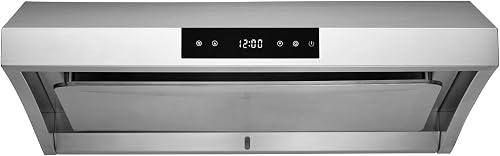


What CFM Actually Means
CFM stands for cubic feet per minute, the volume of air a range hood pulls through its fan each minute. Higher CFM means the hood can clear smoke, steam, grease particles, and cooking odors faster. A hood rated at 400 CFM on paper may deliver noticeably less at the grille once you account for duct bends, length, and resistance, so buying slightly above your calculated minimum is smart practice. The CFM spec on a product page is the max fan speed rating; most hoods have two to six speed settings, and you will use lower speeds for light sauteing and save high speed for searing or boiling large pots.
CFM Rules for Gas Cooktops
Gas burners produce combustion byproducts including carbon monoxide, nitrogen dioxide, and water vapor in addition to cooking grease and steam, which makes ventilation more critical for gas than for electric or induction cooking. The standard rule is 100 CFM for every 10,000 BTU of burner output. A typical four-burner gas range with combined output around 40,000 to 60,000 BTU calls for 400 to 600 CFM. A high-output dual-fuel or professional-style range with 60,000 to 100,000 BTU combined needs 600 to 1,000 CFM from a ducted hood vented directly outside. For a demanding gas setup, the Hauslane UC-PS38 (ASIN B06XWH5S3Q) delivers 950 CFM through its ducted exhaust path and uses baffle filters that hold up to grease-heavy gas cooking.
CFM Rules for Electric and Induction Cooktops
Electric resistance and induction cooktops do not produce combustion gases, so the main concern is capturing cooking grease, steam, and odors. A practical guide is 100 CFM per linear foot of cooktop width. A standard 30-inch electric range translates to roughly 250 to 400 CFM for everyday cooking. Induction cooktops heat food directly and keep the surrounding surface cooler, which generates less ambient steam, so 300 to 400 CFM is often plenty for a 30-inch induction setup. The COSMO COS-63190 (ASIN B00LI92FPU), rated at 380 CFM with a ducted wall-mount design and baffle filters, covers this range comfortably and handles light to moderate electric or induction cooking without overshooting into noisy high-CFM territory.
How Duct Length and Layout Reduce Effective CFM
Every foot of rigid duct, every 90-degree elbow, and every roof or wall cap reduces the airflow the fan actually delivers. A 6-inch round duct run longer than 25 feet can cut effective CFM by 20 to 30 percent. As a practical rule, add 100 to 150 CFM to your calculated requirement for every two elbows in the duct run, and size up if your duct run exceeds 15 feet. Using smooth rigid metal duct instead of flexible corrugated duct also preserves CFM by reducing turbulence. If your kitchen layout forces a long or winding duct path, choosing a hood rated at the top of your range rather than the minimum keeps ventilation effective at the grille.
Ductless Hoods and Why CFM Still Matters
A ductless or recirculating range hood pulls cooking air through charcoal or mesh filters and returns cleaned air to the kitchen rather than exhausting it outside. These hoods work in apartments and kitchens where running ductwork is impractical, but they cannot remove humidity and combustion gases the way a ducted exhaust system can. Because the air passes through filter resistance before returning to the room, you generally need 20 to 30 percent more CFM in a ductless hood than a ducted one to achieve similar odor-clearing results. If you are evaluating a convertible hood that can run either way, budget your CFM as if it will run ductless so you have headroom when the time comes to go ducted.
Matching CFM to Hood Width and Mounting Style
A range hood should be at least as wide as your cooktop, and ideally two to six inches wider on each side to capture rising convection currents before they spread. A 30-inch under-cabinet hood over a standard range pairs naturally with 300 to 600 CFM depending on fuel type. Wall-mount chimney hoods over a 36-inch cooktop benefit from 600 to 900 CFM to cover the wider cooking surface. Island hoods in an open kitchen need higher CFM, often 600 to 1,000, because there are no surrounding cabinets to contain rising steam. The ZLINE KB-30 (ASIN B00E4O0R10), a wall-mount hood rated at 760 CFM with baffle filters and four fan speeds, hits the middle of the recommended range for a 36-inch cooking area under moderate to active cooking conditions.
Common mistakes to avoid
- Buying a hood with just enough CFM on paper, then losing 25 to 30 percent to long duct runs or multiple elbows
- Choosing a ductless recirculating hood and expecting it to match a ducted exhaust system at the same CFM rating
- Ignoring hood width-a narrow hood misses the edges of the cooking surface no matter how high the CFM
- Running flexible corrugated duct instead of smooth rigid metal, which creates turbulence and cuts airflow
- Picking a 1,000-plus CFM hood for a tight, well-sealed home without a makeup air plan, which can cause backdrafting from chimneys or combustion appliances
- Treating the manufacturer CFM spec as the real-world delivery-rated output is measured under ideal lab conditions with zero duct resistance
Frequently asked questions
Is 400 CFM enough for a gas range?
For a standard four-burner gas range with combined output under 40,000 BTU, 400 CFM is adequate for everyday cooking when the duct run is short and straight. If your range pushes 50,000 to 60,000 BTU total, or if you frequently run multiple high-heat burners at once, stepping up to 500 to 600 CFM gives you a meaningful buffer. Duct layout matters too: a 400 CFM hood with two elbows and a 20-foot run may deliver less effective airflow than a 500 CFM hood with a clean, direct path to the exterior.
Do I need more CFM for an induction cooktop than a gas range?
Generally no. Induction cooktops produce no combustion byproducts and keep the surrounding surface cooler, so they generate less ambient steam and grease smoke than gas burners. A 300 to 400 CFM ducted hood typically handles a 30-inch induction surface well for everyday cooking. The bigger factor is cooking style: high-temperature searing and boiling large pots create significant steam regardless of fuel type, so active induction cooks may still prefer 400 to 500 CFM for comfort.
Can a range hood be too powerful for a kitchen?
Yes, in a tightly sealed modern home. Hoods above 400 CFM can depressurize the kitchen enough to cause backdrafting, pulling combustion gases from a gas furnace, water heater, or fireplace back into the living space. Many building codes require a makeup air system when a hood exceeds 400 CFM in a tight house. If you want a high-CFM hood, consult an HVAC contractor about a passive or active makeup air solution before purchasing.
How high should I mount my range hood for best airflow?
Most manufacturers recommend 24 to 30 inches above a gas cooktop and 18 to 24 inches above an electric or induction surface. Mounting too high reduces capture efficiency because rising cooking vapors spread outward before reaching the hood intake. Mounting too low creates a heat and clearance hazard. Always check the installation guide for your specific model, since recommended height can vary based on hood depth and fan power.
Does higher CFM mean a louder range hood?
At maximum fan speed, higher-CFM hoods move more air mass and can be louder than lower-CFM models. The better spec to compare is sone rating, a unit of perceived loudness. Quieter hoods run at 3 sones or below on medium speed. Baffle filters generally create less turbulence noise than mesh filters at equivalent CFM, which is one reason baffle-filtered hoods are preferred for higher-powered cooking setups where the fan runs on high more often.