Over-the-Range Microwave Venting Explained: Ducted, Ductless, and Everything Between
An over-the-range microwave can vent in one of two ways: ducted (exterior) venting pushes cooking air through a duct to the outside, while ductless (recirculating) venting pulls air through a charcoal filter and blows it back into the kitchen. Ducted venting is more effective at clearing smoke, steam, and heat, but requires an existing duct run. Ductless is easier to install anywhere but offers limited performance for heavy cooking.

How Over-the-Range Microwave Ventilation Actually Works
Every over-the-range microwave has a built-in ventilation fan that draws air from the cooktop below through a grease filter on the bottom of the unit. From there, the path splits depending on how the unit is configured: either the air travels through a duct in the cabinet above and exits the house, or a damper redirects it inward through a charcoal filter before returning it to the room. Most OTR microwaves ship set up for recirculating mode because that requires no ductwork, but many models can be converted to ducted operation by changing the damper position and connecting a duct. The grease filters, typically aluminum mesh, catch airborne cooking grease in both modes and should be washed monthly.
Ducted (Exterior) Venting: What It Is and When You Need It
Ducted venting connects your microwave's exhaust fan to the outside through a 3.25-by-10-inch or round 6-inch duct run that exits through a soffit, cabinet, or exterior wall. Because cooking air actually leaves the house, ducted systems remove heat, steam, smoke, and odors far more completely than recirculating alternatives. This matters most on gas ranges, where combustion byproducts and high BTU burners generate significant heat and moisture, and for any cook who regularly sears meat, deep fries, or stir-fries at high temperatures. The main constraint is routing: if there is no existing duct path from the microwave cabinet to an exterior wall or roof soffit, adding one requires cutting through cabinetry or framing, which can be a significant installation project.
Ductless (Recirculating) Venting: Practical Limits and Best Uses
In ductless mode, the fan pushes air through a charcoal filter that adsorbs odor molecules before returning the air to the kitchen. Charcoal filters are effective at reducing cooking smells and catching some fine particles, but they cannot remove heat or water vapor, and they become saturated over time and must be replaced every six to twelve months depending on how often you cook. Recirculating is a reasonable choice for light electric cooking, pasta, vegetables, reheating, where steam volumes are modest and odors are mild. It is also the only practical option in apartments, condos, or kitchens on interior walls where running ductwork to the outside is not feasible. Budget for replacement charcoal filters as an ongoing cost if you choose this route.
Understanding CFM and What It Means for Your Kitchen
CFM, cubic feet per minute, measures how much air the fan can move, and it is the single most important ventilation spec to compare. Most standard over-the-range microwaves fall in the 150-400 CFM range, which is adequate for light-to-moderate cooking on electric ranges. Heavy gas cooking, commercial-style ranges with high-BTU burners, or kitchens that frequently produce a lot of steam benefit from 300 CFM or higher. Keep in mind that a ducted system at 300 CFM performs dramatically better than a recirculating system at 300 CFM, because all 300 CFM of air is actually leaving the house in the ducted case. Fan noise, usually rated in sones, also correlates with CFM; higher airflow typically means a louder fan, so check sone ratings if a quiet kitchen matters to you.
Choosing a Model That Handles Ventilation Well
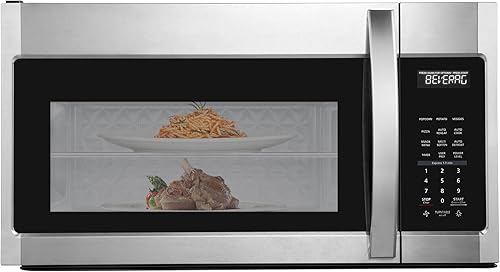
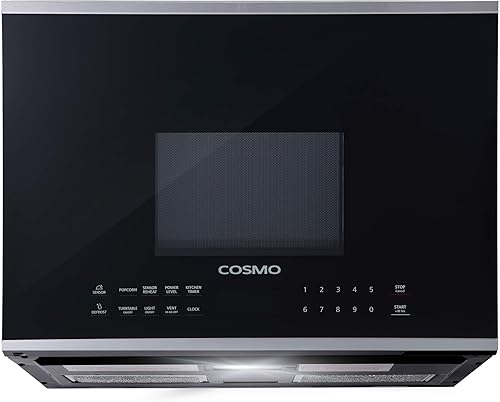
Because CFM and filter data are not always prominent in product listings, focus on a few practical signals: look for multiple fan speed settings so you can match airflow to what you are cooking, confirm the unit ships with a convertible damper if you want the ducted option later, and check that replacement charcoal filters are readily available for the brand before you buy. The BLACK+DECKER EM044KB19 is one of the most purchased OTR microwaves available, offering convection heating alongside its ventilation fan in a 1.9 cubic foot cavity with a 29.9-inch width that fits standard 30-inch cabinets. For buyers who want a larger cavity from a heritage brand, the Frigidaire FFMV1846VS provides 1.8 cubic feet at 1000 watts and has accumulated over 1,800 verified purchases per month at a competitive price point. If you have a narrower 24-inch space, the COSMO COS-2413ORM1SS fits at 23.8 inches wide with a 1.34 cubic foot interior and a 13.6-inch turntable, making it a practical pick where standard 30-inch units will not fit.
Grease Filters: The Part Everyone Forgets to Maintain
Regardless of whether your OTR microwave vents ducted or recirculating, the aluminum mesh grease filters on the bottom of the unit are doing real work every time you cook. Clogged grease filters reduce airflow significantly, in some cases cutting effective CFM by half, and create a fire hazard if grease accumulates heavily enough. Most filters pop out without tools and are dishwasher safe; run them through a cycle once a month if you cook regularly or every two to three months for lighter use. Recirculating models also require separate charcoal odor filters behind the grease screens, and those cannot be washed, they must be replaced. Always confirm what filter consumables a specific model uses before purchasing, since proprietary filters from smaller brands can be hard to source after the initial supply runs out.
Common mistakes to avoid
- Buying a ductless model assuming it will clear steam and heat the same way a ducted system does.
- Never replacing the charcoal odor filter in recirculating mode, it saturates and stops working.
- Ignoring CFM entirely and choosing a microwave only on cavity size or price.
- Skipping grease filter cleaning until airflow is noticeably reduced or a burning smell appears.
- Assuming every OTR microwave can be converted to ducted venting, check the spec sheet for a convertible damper before buying.
- Installing a 30-inch OTR microwave in a 30-inch cabinet without confirming the actual unit width fits with clearance for the mounting bracket.
Frequently asked questions
Can I convert my over-the-range microwave from recirculating to ducted venting?
Many OTR microwaves are sold as convertible, meaning they ship in recirculating mode but include a damper that can be repositioned to allow ducted operation. You also need to install a duct run from the microwave cabinet to an exterior wall, soffit, or roof cap. Check your specific model's installation manual to confirm it supports conversion before purchasing, because not all units offer this option.
How often do I need to replace the charcoal filter in a recirculating OTR microwave?
Most manufacturers recommend replacing the charcoal odor filter every six to twelve months, but this varies based on how frequently you cook and what you cook. If you notice odors lingering in your kitchen longer than usual after cooking, that is a sign the filter is saturated and due for replacement. Grease filters are separate and should be cleaned monthly, charcoal filters cannot be washed and must be replaced.
Is ducted or ductless venting better for a gas range?
Ducted venting is strongly preferable over a gas range. Gas burners produce combustion byproducts, significant heat, and more moisture than electric cooktops, and recirculating charcoal filters are not designed to handle any of those effectively. If your kitchen has an existing duct path, use it. If you must go ductless over a gas range, prioritize a model with the highest available CFM and commit to replacing the charcoal filter more frequently.
What CFM rating do I need for normal home cooking?
For light cooking on electric burners, boiling, sauteing, reheating, 150 to 250 CFM is generally sufficient. For moderate cooking that involves frequent searing, frying, or high-heat stir-frying, look for 300 CFM or higher. Gas ranges benefit from 300-plus CFM regardless of cooking style because of the added heat and combustion output. Remember that these targets apply to ducted systems; in recirculating mode, plan for a higher CFM spec to compensate for the reduced real-world efficiency.
Why does my OTR microwave fan seem weak even on the highest setting?
The most common cause is a clogged grease filter, airflow drops sharply when the mesh is coated with accumulated cooking grease. Remove the filters and wash them in hot soapy water or the dishwasher, then retest the fan. In recirculating mode, a saturated charcoal filter can also restrict airflow and should be replaced. If airflow is still low after cleaning the filters, the fan motor or damper may need service.