Are Induction Cooktops Worth It? Here's the Honest Answer
Induction cooktops deliver fast, precise heat with easy cleanup, but they come with real trade-offs worth knowing before you buy.
Induction cooktops have gone from a niche luxury to a genuine mainstream option, and the question people keep asking is whether they justify the higher price tag. The short answer is yes, for most cooks, but there are a few important caveats. Understanding how induction actually works, what you need to use one, and where it falls short will help you decide if it makes sense for your kitchen.


How Induction Cooking Actually Works
Induction cooktops use electromagnetic coils beneath a flat glass surface to generate heat directly in the pan itself rather than heating a burner or element first. When you place a compatible pot on the zone, the magnetic field causes the metal in the pan to heat up almost instantly. The glass surface around the pan stays relatively cool because only the cookware gets hot, not the cooktop. This is fundamentally different from gas or radiant electric, where heat radiates up from below and much of it escapes into the air around the pot.
The Real Advantages of Induction
Speed is the biggest selling point people notice first. Induction heats water and brings pans up to temperature noticeably faster than gas or electric radiant. Precision is the second big win: induction responds to power adjustments almost instantly, so dropping from a boil to a gentle simmer takes seconds rather than the minute or more gas burners need to settle. Cleanup is dramatically easier because spills and splatters land on a cool surface instead of baking onto hot coils or grates. Safety is another genuine benefit since there is no open flame and the surface itself does not get dangerously hot.
The Cookware Requirement
The most common reason people hesitate is the cookware requirement. Induction only works with pots and pans that contain enough iron or steel to interact with the magnetic field. Cast iron and stainless steel work well; aluminum, copper, and ceramic do not unless they have a magnetic base layer. The simplest test is to hold a magnet to the bottom of the pan. If it sticks firmly, the pan will work on induction. Many modern pots and pans are already induction-compatible, but if you have a full set of aluminum or copper cookware you love, you will need to budget for replacements.
What Induction Cooktops Cost
Entry-level portable induction burners can be found for under $100, which is a low-risk way to try the technology before committing to a built-in unit. Built-in induction cooktops typically start around $300 to $400 for basic two-zone models and range up past $1,000 for premium four- or five-burner configurations with higher wattage and more refined controls. The Frigidaire Gallery FGIC3066TB, a well-reviewed 30-inch four-burner model, carries an 822-review track record and sits in the mid-range of built-in pricing. The AMZCHEF EC-30inch offers a 5-burner, 10,600-watt 30-inch induction cooktop at around $400 with consistently positive buyer feedback.
Electricity Costs vs Gas: Is Induction Cheaper to Run?
Induction is more efficient than both gas and radiant electric because more of the energy produced actually reaches the food rather than escaping as ambient heat. Gas burners transfer roughly 40 percent of their energy to the pan; induction transfers around 85 to 90 percent. Whether your monthly bill goes up or down depends on the relative price of electricity and gas in your area. In regions where natural gas is very cheap, your running costs may be similar or slightly higher with induction. Where electricity is competitively priced or your home already runs on solar, the efficiency advantage often translates to real savings over time.
Who Should and Should Not Buy Induction
Induction makes the most sense if you cook frequently, want easy cleanup, have young children you worry about around a gas flame, or are in an all-electric home where adding a gas line is not practical. It is also a strong choice for anyone who values precise low-heat control for things like melting chocolate or holding a delicate sauce. Induction is less ideal if you own a large collection of non-magnetic cookware and do not want to replace it, or if you cook exclusively with a wok that needs the high, flaring heat of a gas flame. Restaurant-style wok cooking genuinely benefits from the sidewall flame contact that gas provides and that induction cannot replicate.
Getting Started: Built-In vs Portable
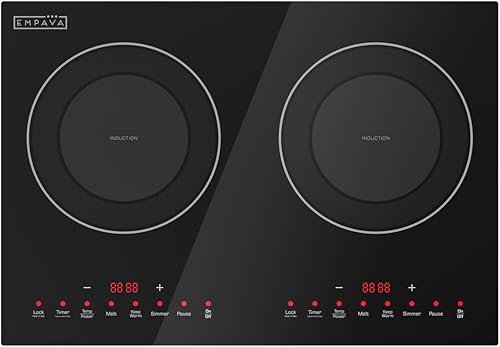
If you are not ready to commit to a full installation, a portable single-burner induction cooktop is an affordable way to test whether induction fits your cooking style. Units like the Empava Double Induction Cooktop offer a two-burner setup that can sit on your counter, require no special wiring, and cost well under $200. For a permanent kitchen upgrade, a 30-inch four- or five-burner built-in induction cooktop drops in the same cutout as most existing electric cooktops and requires a standard 240-volt outlet. Gas-to-induction conversions are more involved since they require running an electrical circuit, so factor that cost in if you are switching fuel types.
Frequently asked questions
Do I need special pots and pans for an induction cooktop?
Yes, induction requires cookware made from or containing a magnetic material like cast iron or stainless steel with a magnetic base. Hold a magnet to the bottom of your existing pans to check. Aluminum, copper, and most glass cookware will not work unless the manufacturer has added a magnetic layer to the base.
Is induction cooking safe?
Induction is considered one of the safest cooking methods available. There is no open flame, and the cooktop surface itself stays relatively cool because the heat generates inside the pan rather than on the glass. Spills are less likely to burn onto the surface, and children cannot accidentally burn themselves by touching the cooktop next to an active zone.
Can I use an induction cooktop in an all-electric home without a gas line?
Yes, that is one of the main reasons people choose induction. Built-in induction cooktops run on a standard 240-volt electrical circuit, the same type used for electric dryers. No gas line is needed, which makes induction a straightforward choice for homes that have never had gas service.
Will an induction cooktop work if the power goes out?
No, induction cooktops require electricity to operate, so they will not function during a power outage. If power reliability is a concern in your area, this is worth factoring into your decision. Gas cooktops with manual ignition can often still be lit with a match when the power is out.
How does induction compare to a smooth-top radiant electric cooktop?
Both use a flat glass surface, but the cooking technology is different. Radiant electric heats a coil or ribbon beneath the glass that then radiates heat upward to the pan. Induction skips the radiant step and heats the pan directly, which makes it faster, more responsive when adjusting heat, and safer since less of the glass surface gets hot. Induction cooktops typically cost more than radiant electric cooktops of the same size.