Why Is My Oven Not Heating Up?
Most oven no-heat problems trace back to a handful of common culprits, here’s how to find yours and decide whether it’s a DIY fix or a service call.
You preheat your oven, wait, and the temperature never climbs. It’s frustrating, but it’s also one of the most common appliance complaints out there. The good news is that most no-heat problems come down to a small list of causes, and some of them are surprisingly easy to sort out on your own. This guide walks you through each one in plain language so you can figure out what’s going on before calling a repair tech.


Check the Basics First
Before assuming something is broken, run through the simple stuff. For electric ranges, confirm the unit is fully plugged in and that the outlet’s dedicated circuit breaker hasn’t tripped, electric ovens often run on a double-pole 240-volt breaker that can trip on just one leg, leaving the clock on but the oven cold. For gas ranges, make sure the gas supply valve behind the unit is fully open and that your home’s gas service is active. Also double-check that the oven isn’t accidentally set to a timer delay or a Sabbath mode, both of which will prevent normal heating.
Electric Oven: Bad Bake or Broil Element
The bake element is the curved heating rod at the bottom of an electric oven; the broil element sits at the top. When either one fails, the oven either won’t heat at all or won’t reach the set temperature. You can often see the problem, a working element glows red-orange evenly, while a failed one may look visibly cracked, have a hole in it, or show dark burn spots. If the element looks damaged, it almost certainly needs to be replaced. Element replacement is one of the more beginner-friendly oven repairs: the part is inexpensive, readily available, and typically held in place by just two screws and a wire connector.
Gas Oven: Faulty Igniter
The igniter is the most common reason a gas oven won’t heat. It does two jobs: it glows hot enough to light the burner, and its electrical draw opens the gas safety valve. When an igniter weakens with age, it may still glow but not get hot enough to pull the valve fully open, so gas never flows and nothing ignites. You’ll often hear a soft clicking or see a faint orange glow inside the oven that never turns into a flame. Replacing a gas oven igniter is a common DIY repair, but if you’re not comfortable working with gas appliances, having a qualified technician do the swap is the safer call.
Temperature Sensor Problems
Both gas and electric ovens use a temperature sensor, a thin probe that pokes into the oven cavity, to tell the control board what the actual temperature is. If this sensor fails or gets bent so it touches the oven wall, the readings go haywire and the oven may refuse to heat or cycle off almost immediately. You can test a sensor with an inexpensive multimeter: its resistance should change in a predictable way as temperature rises (check your oven’s service manual for the exact spec). A bent sensor can sometimes just be straightened; a sensor that reads wildly out of range needs to be replaced.
Control Board or Thermostat Failure
The electronic control board is essentially the brain of a modern oven. When it fails, the oven may show error codes, refuse to respond to inputs, or simply stay cold even though everything else looks fine. Control board replacements tend to be expensive, often $150 to $400 for the part alone, so it’s worth ruling out every other cause first. Older ovens with mechanical thermostats rather than electronic controls can also develop a faulty thermostat, which has a sensing bulb inside the oven cavity connected to the temperature dial. A technician can test both components and tell you whether repair or replacement of the whole range makes more financial sense.
When to Call a Professional
Some repairs are genuinely safe and simple for a handy homeowner: swapping a bake element, replacing an igniter, or straightening a bent temperature probe. Others carry real risk if you get something wrong, anything involving gas line connections, 240-volt wiring, or sealed burner assemblies is best left to a licensed appliance technician. If your range is more than 10 to 15 years old and the repair estimate approaches half the cost of a new unit, it’s worth doing the math on replacement instead. A newer range will also tend to be more energy-efficient, which adds up over time.
Considering a New Range?
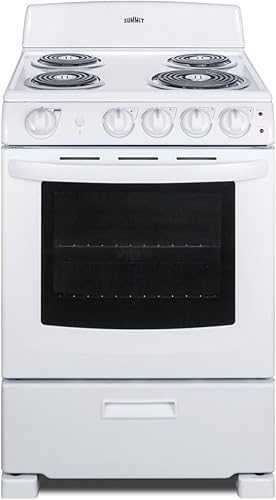
If the repair cost doesn’t make sense, it may be time to start fresh. The Summit Appliance RE2411W is a compact electric freestanding range with 4 burners and 2.9 cu ft of oven space that works well in tighter kitchens. For gas cooking, the GE JGBS30DEKBB is a 30-inch freestanding gas range with a 4.8 cu ft oven and knob controls, solid capacity at a reasonable price point. If you want something with more room, the Samsung NX60A6511SS is a 30-inch gas freestanding range with a generous 6.0 cu ft oven, 5 sealed burners, and 3 oven racks.
Frequently asked questions
Why does my oven turn on but not heat up?
The most likely cause depends on your fuel type. On an electric oven, a burned-out bake element can keep the display and clock working while the cavity stays cold. On a gas oven, a weak igniter may glow without getting hot enough to open the gas valve. A failing temperature sensor can also fool the control board into cutting heat prematurely.
Can I use my gas oven manually if the igniter is broken?
Some older gas ovens can be lit manually with a match or lighter held near the burner opening, but many modern gas ovens use electronic safety valves that only open when the igniter draws the correct current, so manual lighting is not always possible or safe. Check your owner’s manual before trying, and if in doubt, skip it and get the igniter replaced.
How much does it cost to fix an oven that won’t heat?
A bake element typically costs $20, $60 for the part and is often a DIY job. A gas igniter part usually runs $15, $50. A temperature sensor is similarly priced. Control board replacement is the big-ticket item, often running $150, $400 for the part plus labor, which is why it’s worth getting a diagnostic before committing to that repair.
How do I know if my oven’s heating element is burned out?
Turn on the bake function and watch the element at the bottom of the oven, it should glow a steady, even red-orange within a few minutes. If it doesn’t glow at all, glows only in spots, or has a visible crack or blister, it has likely failed and needs to be replaced.
Why does my oven heat up sometimes but not other times?
Intermittent heating is a classic sign of a component that’s failing but not fully dead yet, a weak igniter, a cracked element, or a temperature sensor with an unreliable connection are all common culprits. Intermittent problems can be harder to diagnose than a complete failure, so noting exactly when it happens (cold start vs. after a previous use, low temps vs. high temps) will help a technician pinpoint the issue faster.