Standard Range and Stove Width Sizes: What You Need to Know Before You Buy
Getting the width wrong is one of the most common and costly range-buying mistakes, here is how to get it right.
Ranges come in a handful of standard widths, but walk into any appliance store without measuring first and you can easily end up with a unit that is two inches too wide for your cutout. The most common size in American homes is 30 inches, but kitchens fitted with compact models, RV setups, or professional-style appliances follow completely different standards. Understanding which width you need, and why the other dimensions matter too, takes just a few minutes and can save you a serious headache on delivery day.


The Four Standard Widths at a Glance
Residential ranges are manufactured in four main widths: 20 inches, 24 inches, 30 inches, and 36 inches. The 30-inch size dominates the market and fits the cutout found in the vast majority of U.S. kitchens built in the last 50 years. Twenty-four-inch ranges are a popular choice for apartments, condos, and smaller galley kitchens where counter space is tight. Twenty-inch models are the narrowest residential option and are common in RVs, studio apartments, and tiny homes. The 36-inch width steps up to professional-style territory, offering more burners and a larger oven cavity for households that do serious cooking.
How to Measure Your Kitchen Opening
Before shopping, measure the width of the existing cutout or the gap between your cabinets at three points: the front, the middle, and the back. Cabinets are rarely perfectly parallel, so take the smallest measurement as your constraint. You also want at least 1 inch of clearance on each side of a freestanding range for heat dissipation and to allow the anti-tip bracket to seat properly. Write down the depth of the space too, most standard ranges run 25 to 29 inches deep, not counting the door handle or backguard, so shallow cabinetry can be a surprise obstacle.
30-Inch Ranges: The Everyday Standard
A 30-inch range typically offers four burners, an oven cavity in the 4.8 to 6.0 cubic-foot range, and fits the standard base-cabinet module used in most American kitchen designs. Gas, electric, and induction models are all widely available at this width, giving you the most options at almost every price point. If you are replacing a range and the old one was 30 inches, buying another 30-inch model is almost always a straightforward swap. The GE JGBS30DEKBB is one example: a 30-inch freestanding gas range with a 4.8 cu ft oven and open-burner heating.
Compact 20- and 24-Inch Ranges
If your kitchen opening is 24 inches or less, you are in compact-range territory. These models fit apartments and small rentals where a full-size unit simply will not go. A 24-inch range usually has four burners and an oven cavity around 2.9 to 3.7 cubic feet, smaller than a standard oven but perfectly workable for everyday cooking. Twenty-inch ranges go even narrower and are common in RV kitchens and tiny-home builds; they typically have three or four burners and a cavity under 2.5 cubic feet. The Summit Appliance WEM110 is a 20-inch electric freestanding model with 4 burners and a 2.46 cu ft oven capacity, built for spaces where every inch counts.
36-Inch Ranges: More Burners, More Oven
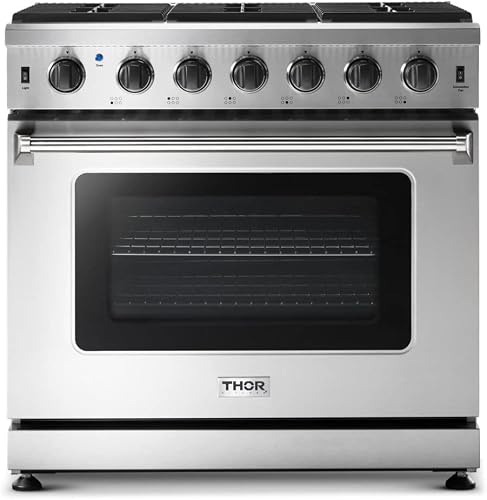
A 36-inch range is the starting point for the professional-style segment. You get five or six burners instead of four, which makes a real difference when you are cooking a big meal with multiple pots going at once. Oven cavities at this width often reach 5 to 6 cubic feet or more, and many models offer convection as standard. The tradeoff is that your cabinetry must accommodate the wider cutout, not a given in kitchens designed around the 30-inch module. If you are remodeling and can accommodate it, a 36-inch model like the Thor Kitchen LRG3601U (a 6-burner gas range with a 6.0 cu ft oven) is a meaningful upgrade for a cook who uses the stovetop heavily.
Width Is Not the Only Measurement That Matters
Height and depth are just as important as width but are easier to overlook. Most freestanding ranges stand about 36 inches tall with the backguard, which aligns with standard countertop height. Some models run a few inches taller or shorter, so measure your countertop clearance if you have cabinetry overhead. Depth matters when cabinets border the front of the range: standard ranges are 25 to 29 inches deep (excluding handles), and a deep door handle can protrude beyond the counter edge. Always check all three dimensions on the product spec sheet, not just the width.
Freestanding vs. Slide-In: Does Width Change?
Slide-in ranges use the same standard widths as freestanding models, but the fit is tighter by design. A slide-in is meant to drop flush between two base cabinets, so you need an accurate opening measurement with very little tolerance. Freestanding ranges have finished side panels and can stand alone, giving you a little more flexibility if the opening is slightly uneven. If you are replacing a slide-in with a slide-in, confirm the cutout is within the tolerances listed by the manufacturer, usually a quarter inch or less on each side.
Frequently asked questions
What is the most common stove width in the U.S.?
Thirty inches is by far the most common range width in American homes. It fits the standard 30-inch base-cabinet module that has been used in residential kitchen design for decades. If you are replacing an existing range without remodeling, a 30-inch model will almost certainly drop right in.
Can I replace a 30-inch range with a 36-inch range without remodeling?
Generally no, not without modifications. A 36-inch range needs a 36-inch opening, which means moving or replacing cabinetry on one or both sides. In some cases homeowners remove one base cabinet to open the space, but that is a remodeling project, not a simple appliance swap.
Do all 30-inch ranges have the same depth?
No. Depth varies by model, typically running from about 25 to 29 inches excluding handles and backguard. A few professional-style models are deeper still. Always check the product spec sheet for depth before ordering, especially if overhead cabinetry or a narrow kitchen layout is a concern.
What size range fits a compact apartment kitchen?
Most apartment kitchens accommodate a 24-inch range. If the opening is even tighter, common in studio apartments, lofts, or RV kitchens, a 20-inch model may be the only residential option that fits. Measure the opening carefully before assuming a 24-inch will work.
Is a 36-inch range worth it for a home kitchen?
It depends on how much you cook. The extra burners and larger oven cavity are genuinely useful for households that regularly cook multi-dish meals or entertain often. If you rarely use all four burners on a 30-inch range, the wider model is hard to justify given the cabinet work required to fit it.