Gas vs Electric Wall Oven: Why Electric Wins by Default (and What to Look For)
True gas double wall ovens are effectively off the market today. Nearly every built-in wall oven sold by mainstream and premium brands runs on a 240-volt electric connection, with convection heating as the standard. If you have a gas line you love for cooking, the practical solution is a gas cooktop or range paired with an electric wall oven -- that combination is exactly how most serious home kitchens are set up.


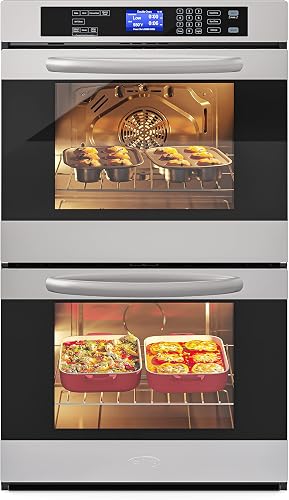
Why Gas Wall Ovens Have Largely Disappeared
Gas ovens require a burner inside a sealed cavity, which creates ventilation challenges and makes precise temperature control harder to engineer at the wall-oven form factor. Electric resistance and convection heating are simply a better fit for a built-in box. Major appliance manufacturers -- GE, Samsung, Frigidaire, ZLINE, and others -- have standardized almost entirely on electric for their wall oven lineups. The very few gas wall oven models that exist tend to be single-cavity, regional, or special-order products that are difficult to find in stock and even harder to service.
How Electric Wall Ovens Heat Food
Electric wall ovens use resistance heating elements at the top and bottom of each cavity, typically drawing between 4,000 and 8,800 watts at 240 volts. Most current models add a convection fan that circulates hot air around food, which shortens roast times, browns more evenly, and lets you use multiple racks at once. The COSMO COS-30EDWC, for example, is a 30-inch built-in double wall oven with 5.0 cubic feet of capacity per cavity and a 4,800-watt convection system. The KoolMore KM-WO30D-SS steps that up to 8,500 watts across a combined 10.0 cubic feet of total capacity -- useful when you are running both cavities hard at the same time.
What Electric Gives You That Gas Cannot Match in a Wall Oven
Electric ovens hold a set temperature more steadily than gas because there is no combustion cycle turning on and off. Convection electric models distribute that steady heat uniformly, which matters for baking -- cookies and sheet cakes cook at the same rate whether they sit on the top rack or the bottom. Broiling is also sharper with an electric element than with a gas burner positioned at the top of the cavity. The Samsung NV51K6650DG/AA, a 30-inch built-in double wall oven rated 4.5 stars, pairs electric convection with a stainless steel finish and fits the standard 30-inch cutout, which covers most kitchen remodels without modification.
The Case for Gas Cooking -- Just Not in Your Wall Oven
Gas fuel type genuinely shines on the cooktop, where open flames give you instant, visible heat adjustment and high BTU output for searing. If you prefer gas for stovetop cooking, the right approach is a dual-fuel kitchen: a gas cooktop or freestanding gas range for surface cooking, and an electric wall oven mounted separately in your cabinetry. This setup is common in upgraded kitchens and gives you the best of both fuel types. The wall oven installation is independent of your cooktop fuel choice, so switching to an electric wall oven does not require you to give up gas burners.
Key Specs to Compare When Choosing an Electric Double Wall Oven
Capacity in cubic feet is the most practical number to evaluate -- combined totals in the 10 cubic foot range, like the KoolMore KM-WO30D-SS at 10.0 cu ft or the Frigidaire FCWD3027AS at 10.6 cu ft, give you real flexibility for holiday cooking when both cavities are running simultaneously. Wattage determines how fast the oven reaches temperature and how well it recovers after you open the door; 8,500 watts is a strong spec for a full-size double unit. Width matters for fit: most standard cutouts are 30 inches, though some models are designed for 27-inch or 24-inch openings, so measure your cabinet before ordering. Installation type -- built-in wall mount versus above a warming drawer -- affects how the unit is framed into cabinetry.
Installation and Running Cost Differences
An electric double wall oven needs a dedicated 240-volt, 40- to 50-amp circuit -- if your kitchen does not already have one, budget for an electrician to run the wire and install the breaker before your oven arrives. Gas wall ovens would require a gas line routed into the wall cavity, which is its own cost and code-compliance project. On a per-BTU basis, natural gas is often cheaper than electricity in many regions, but because electric ovens are better insulated and lose less energy to exhaust, the real-world operating cost difference is smaller than it looks on paper. Most homeowners find the installation simplicity and cooking consistency of an electric wall oven the right tradeoff.
Common mistakes to avoid
- Ordering a 30-inch oven for a 27-inch cutout -- always measure the rough opening before selecting a model.
- Assuming any wall oven can run on a standard 120-volt outlet -- double wall ovens require a 240-volt dedicated circuit.
- Overlooking combined cavity capacity and focusing only on the price tag, then discovering both cavities cannot fit a standard roasting pan.
- Expecting gas-style open-flame searing from a wall oven broiler -- broiling works best when the pan sits close to the element.
- Buying a gas wall oven online without confirming current in-stock availability and local service support -- inventory for gas wall ovens is extremely thin.
- Ignoring the installation type spec -- a model listed as above-a-warming-drawer will not frame correctly into a standard stacked wall oven cutout.
Frequently asked questions
Do gas double wall ovens exist?
They exist in theory but are extremely difficult to find new and in stock from mainstream retailers. Virtually every double wall oven on the market today runs on electricity. If a gas oven is important to you, you are likely looking at a single-cavity gas wall oven from a specialty brand, or more practically, a freestanding gas range rather than a built-in wall unit.
Is an electric wall oven good for baking?
Electric convection ovens are generally considered ideal for baking because the heating elements maintain a consistent temperature without the moisture and cycling that a gas burner introduces. The convection fan distributes heat so that multiple pans on different racks bake at a similar rate. Most dedicated bakers prefer electric for this reason.
What voltage does a double wall oven need?
All double wall ovens in this category require a 240-volt electrical connection, the same type used by electric dryers and ranges. A dedicated 40- to 50-amp breaker is standard. This is not something you can run from a regular household outlet, so factor in an electrician visit if your kitchen does not already have that circuit.
Can I pair a gas cooktop with an electric wall oven?
Yes, and this is one of the most popular kitchen configurations among home cooks who want gas for stovetop searing and electric precision for baking. A gas cooktop or gas range connects to your gas line for surface cooking, while the electric wall oven mounts separately in the cabinet stack. The two appliances operate completely independently, so there is no compatibility issue.
How much capacity do I need in a double wall oven?
For a household that regularly cooks full holiday meals or runs both cavities at the same time, aim for at least 5 cubic feet per cavity -- a combined total of 10 cubic feet or more. Smaller cooks or tighter cabinets can manage with around 5 cubic feet total if only one cavity will be used at a time. Check that a standard 9-by-13-inch baking pan fits on a single rack before committing to any model.