What to Look for When Buying a Double Wall Oven
Choosing a double wall oven comes down to four things: the width that fits your cabinet cutout (27 or 30 inches is standard), the combined capacity you actually need across both cavities, whether you want electric convection for even baking, and how much wattage your kitchen circuit can support. All current models run on a 240-volt electric connection, so there is no gas option to weigh against electric here.


Start With Your Cabinet Cutout
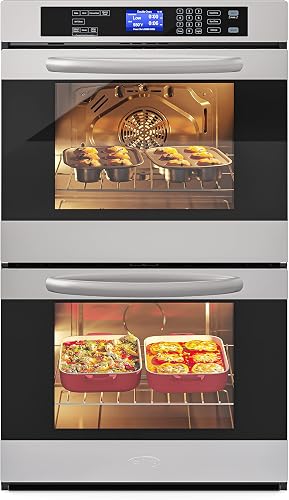
The cabinet opening is non-negotiable, a 30-inch oven will not drop into a 27-inch cutout, and having the wall modified costs real money. Most American kitchens that were built or remodeled with a wall oven in mind have a 30-inch cutout, but older homes and condos often have 27-inch spaces. Measure the width, height, and depth of the opening before you look at a single spec sheet. The COSMO COS-30EDWC, for example, fits a standard 30-inch cutout at exactly 30 inches wide, while the KoolMore KM-WO30D-SS slots into a narrower 23.5-inch opening. Match the unit to what you have, not the other way around.
Total Capacity Across Both Cavities
A double wall oven's capacity spec usually reflects the combined cubic footage of the upper and lower cavities together. You will see figures ranging from about 5 cubic feet on the lower end to over 10 cubic feet on larger models. The Samsung NV51K6650DG/AA, for instance, offers 5.1 cu ft combined, which suits smaller households cooking one or two dishes at a time. The KoolMore KM-WO30D-SS jumps to 10.0 cu ft combined, a practical size for households that regularly cook a full holiday meal, a large roast in one cavity and side dishes in the other simultaneously. Think about how many racks you need loaded at once, not just the biggest holiday you can imagine.
Electric Convection Is the Default, and That Is a Good Thing
Every double wall oven on the market today is electric, running on a 240-volt circuit. The more meaningful heating question is whether the oven uses convection. Convection means a fan circulates hot air around the food, which bakes more evenly, browns more consistently, and cuts cooking time compared to a standard radiant element alone. Most current models, including the COSMO COS-30EDWC and the KoolMore KM-WO30D-SS, use electric convection as their primary heating method. If a model lists only radiant or ceramic heating with no fan, expect less uniform results, particularly on the lower rack.
Wattage and Your Electrical Circuit
Wattage tells you how hard the oven can heat, which affects preheat speed and recovery time after you open the door. Budget models may draw 4,000 to 5,000 watts total; mid-range and larger units often draw 7,000 to 8,500 watts or more across both cavities. The COSMO COS-30EDWC draws 4,800 watts, while the KoolMore KM-WO30D-SS draws 8,500 watts. Before purchasing, check that your kitchen has or can support a 240-volt, 40- to 50-amp dedicated circuit, higher-wattage ovens may require a 50-amp breaker, and wiring upgrades add to the total installation cost.
Width Determines Rack Space, Not Just Fit
A 30-inch-wide oven does more than fit a 30-inch opening, it gives you noticeably more usable rack space inside each cavity than a 27-inch or narrower model. A standard half-sheet pan (18 by 13 inches) slides comfortably into a 30-inch cavity but can be tight in a 27-inch unit depending on the interior dimensions. If you bake on sheet pans regularly, prioritize a 30-inch unit. If your cutout is fixed at 27 inches or the space is a kitchen island column, confirm the interior dimensions match the pans you actually use.
Installation Type and Finish
Most double wall ovens are designed for built-in wall installation, meaning they trim flush with surrounding cabinetry. A handful of models are listed as wall-mount or freestanding, which changes the framing requirements. Finish choices are typically stainless steel, black stainless, or matte black, and none of these affect performance, pick whatever matches your existing appliances. Weight is worth noting at installation time: units commonly run from 200 to 290 pounds, so professional installation and a properly reinforced cabinet are standard requirements, not optional extras.
Common mistakes to avoid
- Ordering a 30-inch oven for a 27-inch cutout, or vice versa, without measuring first.
- Confusing combined capacity with per-cavity capacity; 10 cu ft combined means roughly 5 cu ft per oven, not 10 per cavity.
- Ignoring wattage draw and discovering the existing circuit breaker is undersized after delivery.
- Assuming both cavities can run at full power simultaneously without checking the electrical load spec.
- Buying based on price alone without confirming the unit will actually fit the cabinet depth.
- Overlooking the installation weight, units over 250 lb need two installers and a reinforced cabinet, which affects the real total cost.
Frequently asked questions
Do double wall ovens come in gas?
No. Double wall ovens are electric-only appliances and require a 240-volt circuit. Gas wall ovens exist as single-cavity units in some markets, but the double wall oven category is entirely electric. If you want gas cooking, that happens at the cooktop or range, not in a wall oven.
Can I use both cavities at the same time at different temperatures?
Yes, that is the main reason to buy a double wall oven over a single unit. Each cavity has its own independent controls, so you can bake a casserole at 325 degrees in the lower oven while roasting vegetables at 425 degrees in the upper oven at the same time. Just confirm that your electrical circuit can handle the combined draw when both are running.
What is the difference between a 27-inch and a 30-inch double wall oven?
Width affects both the cabinet fit and the interior rack dimensions. A 30-inch unit has more usable interior space, standard half-sheet pans fit more comfortably, and generally more capacity in each cavity. A 27-inch model is the right choice only if your existing cabinet cutout is 27 inches, since widening the opening is a structural job that adds significant cost.
Is convection worth it in a double wall oven?
For most home cooks, yes. A convection fan circulates hot air, which reduces hot spots, browns food more evenly, and cuts baking time by roughly 10 to 25 percent compared to radiant heat alone. Nearly all current double wall oven models include convection as standard. If you are comparing models and one lacks a fan, treat that as a meaningful drawback for everyday baking.
How much does it cost to install a double wall oven?
Installation cost depends on whether your cabinet cutout already matches the new unit's dimensions and whether your electrical circuit is adequate. If the cutout fits and the wiring is in place, professional installation by an appliance technician typically runs a few hundred dollars. If the cabinet needs modification or the circuit needs upgrading to a 50-amp breaker, costs can climb significantly, get an electrician's estimate before you order.