Picking the Right Countertop Microwave: What Actually Matters
Choose a countertop microwave by matching three specs to your actual cooking habits: wattage (900-1200W handles nearly every home kitchen task well), interior capacity in cubic feet (0.7-1.2 cu ft works for most households), and external dimensions that fit your counter with a few inches of ventilation clearance on each side. Once those three align, extras like inverter technology, power levels, and turntable size become the tiebreakers.


Wattage: The Number That Determines Cooking Speed
Wattage tells you how quickly and evenly a microwave heats food. Models below 800W handle basic reheating and popcorn but struggle with dense items like frozen entrees or thick cuts of meat, often leaving cold centers. The 900-1200W range is the sweet spot for home cooking. The Panasonic NN-SN65KB runs at 1200W with inverter technology, which distributes power more smoothly than a standard magnetron cycling on and off, producing even results on delicate foods. At the other end, the COMFEE EM720CPL-PMB operates at 700W and is genuinely capable for reheating leftovers and defrosting lighter items; just expect longer cook times on anything thick or frozen solid. If you regularly cook full portions rather than simply reheating, do not settle for less than 1000W.
Capacity and Interior Size: Match the Oven to Your Cookware
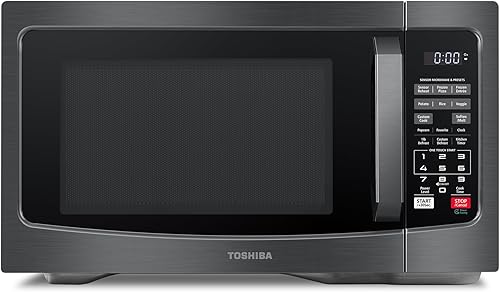
Interior capacity in cubic feet tells you how large a dish will actually fit. A 0.7 cu ft microwave like the COMFEE EM720CPL-PMB, which measures 17.3 inches wide, handles standard dinner plates and most mugs just fine but will not clear a 9x13 casserole. For a household of two to four people, 1.0-1.3 cu ft is the practical minimum. The Toshiba EM131A5C-BS offers 1.2 cu ft with a 12.4-inch turntable and a 20.6-inch exterior width, fitting most plates without the dish scraping the walls. If you routinely heat large covered dishes or want to fit a full pizza, look toward 1.6 cu ft and up, and always confirm the turntable diameter matches your largest plate before you buy.
External Dimensions and Counter Clearance
Every countertop microwave needs breathing room for its vents, typically at least 2-3 inches on each side and above. Measure your available counter width, depth, and any overhead cabinet height before shopping. The COMFEE EM720CPL-PMB at 17.3 inches wide and 10.2 inches tall slides under low cabinets in apartments and tight kitchens with ease. The Toshiba EM131A5C-BS at 20.6 inches wide and 11.8 inches tall needs roughly 24-25 inches of counter width once clearance is factored in. Also check that the door swings clear of adjacent appliances; most microwave doors extend several inches past the unit when fully open. Blocking side or rear vents shortens the life of the unit and can create a safety concern over time.
Inverter Technology vs. Standard Microwave: Does It Matter?
A conventional microwave runs its magnetron at full power and cycles it on and off rapidly to simulate lower settings. Inverter microwaves run at a true, continuous lower wattage instead of pulsing, which heats food more evenly from edge to center. The practical payoff shows up most during defrosting, where standard models tend to partially cook the edges while the center stays icy, and when reheating dense leftovers where texture matters. The Panasonic NN-SN65KB is a widely purchased inverter model at 1200W with 11 power levels and a 13.4-inch turntable; it consistently draws strong ratings across tens of thousands of buyers. For basic daily reheating, a standard 1000W model like the Toshiba EM131A5C-BS still does a very solid job; inverter is a meaningful step up, not a requirement.
Power Levels: Why Counting Them Matters
Power levels let you reduce cooking intensity for tasks that need gentler heat, like softening butter, melting chocolate, or defrosting without cooking the edges. Five or fewer power levels gives you rough control and is fine for basic use. Ten or eleven levels lets you fine-tune precisely. The Panasonic NN-SN65KB carries 11 power levels, and because it uses inverter technology each level is a genuinely different heat output rather than a different cycling pattern. The Toshiba EM131A5C-BS also offers 10 power levels at a lower price point. If your microwave use is limited to reheating coffee and thawing bread, a simpler dial unit is fine. If you defrost raw protein weekly or warm sauces you don't want broken, count the power levels before you commit.
Budget Tiers and Controls: What You Actually Get at Each Price
Under $100 buys 700-900W, 0.7-1.0 cu ft, and reliable button controls from brands like Farberware, COMFEE, and BLACK+DECKER. These handle daily reheating without complaint and are the right call for apartments, offices, or light-use kitchens. In the $100-$200 range, wattage climbs to 1000-1200W, capacity reaches 1.0-1.3 cu ft, and inverter options appear. The Toshiba EM131A5C-BS sits squarely here at 1000W, 1.2 cu ft, and carries over 32,000 buyer reviews at a 4.4-star rating. Above $250 you are mostly paying for inverter capability in a larger cavity, premium stainless finishes, or commercial-grade construction. For most home cooks, the $150-$280 inverter tier delivers the best real-world performance per dollar. Push-button keypads outlast touchscreens in everyday use; if easy-clean controls matter, look for a stainless interior as well.
Common mistakes to avoid
- Buying by brand name alone without checking wattage, which has a bigger impact on real-world cooking speed than the label on the front
- Choosing a capacity that sounds large on paper but does not actually fit your counter once ventilation clearance is added on all sides
- Skipping the turntable diameter check and discovering a full-size dinner plate cannot rotate without hitting the walls
- Assuming factory preset buttons cook correctly out of the box when default times rarely match your specific food brand or portion size
- Overlooking inverter technology when defrosting is a regular task, then dealing with cooked edges and frozen centers every time
- Buying a 700W model to save money when the primary use is cooking full meals, resulting in long cook times and uneven heating
Frequently asked questions
What wattage is good enough for everyday cooking?
For most home kitchens, 1000W hits the right balance between speed and price. It reheats leftovers quickly, handles defrosting without constant attention, and cooks simple recipes without the long wait times common at 700W. If you only warm beverages or heat single portions, 700-800W is sufficient and saves counter space and cost.
How much interior capacity does a family of four need?
A 1.2-1.6 cu ft interior is a practical target for a family of four. That range accommodates standard casserole dishes, large dinner plates, and most covered containers without cramming them against the walls. Models below 1.0 cu ft work for one or two people but require multiple heating rounds when cooking for a group.
Is inverter technology worth the extra cost?
It depends on how you use the microwave. If you defrost raw meat, warm delicate sauces, or soften butter regularly, inverter technology produces noticeably better results because it sustains steady low power rather than pulsing full power on and off. For straightforward reheating and boiling water, a standard electric model at the same wattage performs just as well and costs less.
How do I know if a countertop microwave will actually fit my counter?
Measure your available width, depth, and ceiling height before you shop, then add 2-3 inches to the manufacturer dimensions on each side for ventilation. Also check that the door can swing fully open without hitting a cabinet, since most doors extend several inches beyond the unit when open. The exterior footprint is consistently 3-5 inches larger than the interior cavity, so never size by volume alone.
What is a good countertop microwave for a small kitchen?
For tight counter space, focus on compact models in the 0.7-0.9 cu ft range. The COMFEE EM720CPL-PMB measures 17.3 inches wide and 10.2 inches tall and has over 28,000 buyer reviews at 4.4 stars, making it one of the most proven compact options available. If you want a step up in interior room while keeping a reasonable footprint, the Toshiba EM131A5C-BS at 20.6 inches wide and 1.2 cu ft is a well-balanced middle choice that fits most standard kitchens without dominating the counter.