Microwave Size Guide: How Many Cubic Feet Do You Actually Need?
Countertop microwaves range from about 0.7 cubic feet (compact) up to 2.2 cubic feet (large family size). The right capacity depends on your household size, the dishes you heat most often, and how much counter space you can spare. A single person or small apartment kitchen does fine with 0.7 to 0.9 cu ft, while a family cooking larger plates and casseroles should look at 1.5 cu ft or above.


What Cubic Feet Actually Means Inside a Microwave
Cubic feet is the total interior cooking volume of the microwave cavity. A 0.7 cu ft model measures roughly 13 inches wide inside, enough for a standard dinner plate or a mug. A 1.2 cu ft unit opens up to about 12 to 13 inches of turntable diameter, fitting most 10-inch dinner plates with room to spin. At 2.0 cu ft and above, the cavity is large enough to hold a 9x13-inch casserole dish or a large bowl without squeezing. Cubic feet is a more reliable shopping number than exterior dimensions because it tells you what actually fits inside, not how much counter space the box takes up.
Compact Size: 0.7 to 0.9 Cubic Feet
Compact microwaves in the 0.7 to 0.9 cu ft range are the right call for studio apartments, dorm rooms, offices, or anyone who mainly reheats single servings. The COMFEE' EM720CPL-PMB at 0.7 cu ft runs 700 watts with 11 power levels, measures just 17.3 inches wide, and has earned over 28,000 buyer ratings. The Frigidaire EMW733BLACKAMZ is another well-bought compact at 0.7 cu ft, only 17.8 inches wide with a touch-and-button control panel. Expect to fit a standard dinner plate but not a wide mixing bowl or a large pizza container. Wattage in this size class typically runs 700 to 900 watts, which adds a little extra time on dense foods compared to larger models.
Mid-Size: 1.0 to 1.4 Cubic Feet
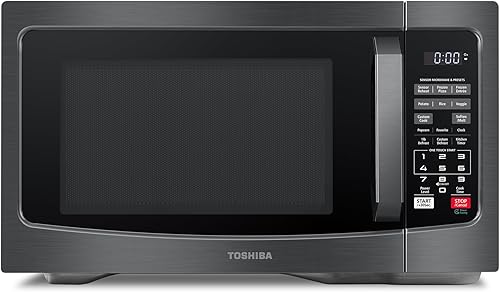
The 1.0 to 1.4 cu ft range is the most popular for good reason: it handles everyday household cooking without dominating the counter. The Toshiba EM131A5C-BS at 1.2 cu ft pairs a 12.4-inch turntable with 1,000 watts and 10 power levels across a 20.6-inch-wide exterior, and it has over 32,000 buyer reviews backing it up. The Panasonic NN-SN65KB also lands at 1.2 cu ft but steps up to 1,200 watts with inverter technology, which delivers steadier, more even heat rather than cycling power on and off. If you are cooking for two people or reheating family leftovers a few nights a week, this size range covers nearly everything without sacrificing much counter real estate.
Large Size: 1.5 to 2.2 Cubic Feet
Households of four or more, or anyone who regularly heats casseroles, large soup bowls, or full-sized dinner plates for multiple people, should consider 1.5 cu ft and up. The GE JES2051SNSS at 2.0 cu ft runs 1,200 watts with 10 power levels, carries a 16-inch turntable, and measures 24.09 inches wide on the counter. At this size you can fit a standard 9x13 baking dish for reheating leftovers or defrosting a larger cut of meat. The tradeoff is footprint: a 2.0 cu ft countertop model typically needs 23 to 25 inches of counter width, which is a meaningful chunk of workspace in most kitchens.
How Wattage and Cubic Feet Work Together
Capacity and wattage are separate specs, but they tend to travel together. Compact 0.7 cu ft models commonly run 700 to 900 watts, mid-size 1.2 cu ft models land around 1,000 to 1,200 watts, and larger 2.0 cu ft units often hit 1,100 to 1,250 watts. Higher wattage means faster, more even heating, but it also draws more electricity. If you are choosing between two similarly sized microwaves, the higher-wattage model will defrost and reheat noticeably faster, which matters if you cook under time pressure. For basic reheating and coffee warming, 900 watts is fine; for defrosting dense proteins or cooking from frozen, 1,000 watts or above makes a real difference.
Turntable Diameter: The Practical Limit on What Fits
The turntable diameter inside the microwave is often a tighter constraint than the cubic footage number suggests. A 0.7 cu ft microwave may have a 10-inch turntable, which stops a standard 10.5-inch dinner plate from spinning freely. The Farberware compact at 0.7 cu ft lists a 10.6-inch turntable, which clears most dinner plates but just barely. Step up to a 1.2 cu ft model like the Toshiba EM131A5C-BS with its 12.4-inch turntable, and standard plates spin without catching. At 2.0 cu ft, the GE JES2051SNSS provides a 16-inch turntable, wide enough for oversized bowls and most casserole lids. Before buying, check the turntable spec against the diameter of your most-used dishes.
Common mistakes to avoid
- Buying by exterior dimensions instead of interior cubic feet, then discovering the cooking cavity is smaller than expected
- Choosing a 0.7 cu ft model to save counter space, but finding that standard dinner plates do not spin freely on a 10-inch turntable
- Assuming bigger always means faster, when wattage is actually the speed driver, not capacity alone
- Overlooking the turntable diameter spec and ordering a microwave that cannot accommodate your everyday dishes
- Sizing up to 2.0 cu ft for a two-person household, then living with a 24-inch appliance that crowds the counter every day
- Treating cubic feet as an exact comparison across brands, when cavity shape affects what actually fits regardless of the volume number
Frequently asked questions
What size microwave do I need for a family of four?
A 1.5 to 2.0 cubic foot microwave is a solid fit for a four-person household. It gives you enough interior room to reheat a full dinner plate per person and handle casserole dishes without crowding. The GE JES2051SNSS at 2.0 cu ft with a 16-inch turntable and 1,200 watts is a practical example of this size class. If counter space is limited, a 1.2 cu ft model can still work if you reheat in batches rather than all at once.
Is 0.7 cubic feet big enough for everyday use?
For one person or occasional reheating, 0.7 cu ft handles mugs, small plates, and single-serve containers without trouble. The constraint is the turntable, which on most 0.7 cu ft models runs about 10 inches in diameter. Standard 10.5-inch dinner plates may not spin freely, meaning you need to stop and rotate food manually. If that sounds like extra work, stepping up to 0.9 or 1.0 cu ft buys a noticeably more usable interior without adding much counter footprint.
Does a larger microwave use more electricity?
Wattage determines energy draw, not cubic feet directly. A large 2.0 cu ft microwave at 1,200 watts uses the same electricity per minute as a compact model also rated at 1,200 watts. The bigger variable is run time: if a lower-wattage compact takes longer to heat the same food, it may consume similar energy overall. For most households, the wattage difference between a 0.9 and a 1.2 cu ft model is small enough that electricity cost is not a meaningful factor in the size decision.
What is the difference between 1.2 and 1.6 cubic feet in practice?
Going from 1.2 to 1.6 cu ft usually adds two to three inches of interior width and a slightly larger turntable, roughly 14 to 15 inches instead of 12. That means wider bowls and oval dishes are less likely to clip the walls as they rotate. The exterior footprint also grows, typically adding an inch or two of width on the counter. For most households the 1.2 cu ft size is sufficient; the step up to 1.6 matters most if you regularly heat wide, flat dishes or use microwave-safe covers that extend past the plate edge.
Can I use a countertop microwave in a small kitchen?
Yes, but measure your available counter depth and width before ordering. Most countertop microwaves need at least 3 inches of clearance on the sides and top for ventilation, so add that to the listed exterior dimensions. A compact 0.7 cu ft model like the COMFEE' EM720CPL-PMB at 17.3 inches wide is genuinely small and fits on shallow counters easily. If counter space is very limited, a mid-size 1.2 cu ft model around 20 to 21 inches wide can still work if you position it in a corner or on a dedicated shelf rather than in the main prep zone.