What to Look for When Buying a Kitchen Range (Without Overcomplicating It)
Choosing a kitchen range starts with four decisions: fuel type (gas, electric, or dual fuel), width (30 inches fits most kitchens), oven capacity in cubic feet, and whether you want a freestanding or slide-in installation. Get those four right and you will cut a crowded market down to a short, manageable list.


Start With Fuel Type: Gas, Electric, Dual Fuel, or Induction
Gas ranges require a natural gas or liquid propane line behind the stove, if your kitchen does not have one, adding it costs money and a licensed plumber. Electric ranges run on a 240-volt outlet (sometimes listed as 220-volt), which most American homes already have, making them the default for kitchens without a gas hookup. Dual-fuel ranges combine gas burners on top for precise BTU control with an electric convection oven below for even baking; they require both utilities and carry the highest price tag of the three main types. Induction is a subset of electric where elements heat cookware magnetically rather than with a glowing element, so the surface itself stays cool and spills wipe off fast, but your pots and pans must be induction-compatible. Check your utility situation before you get attached to any particular model.
Width: Why 30 Inches Is the Standard and When to Deviate
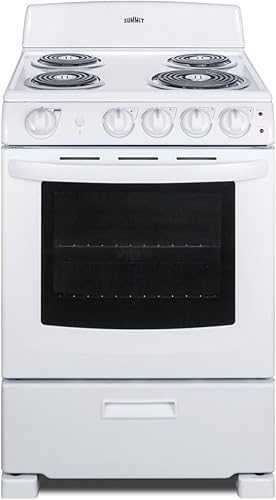
The 30-inch freestanding range fits the rough opening in the vast majority of U.S. kitchens built after the mid-1970s. If you are replacing an existing range, measure the opening width directly rather than guessing from the old appliance, because exterior width and cutout width are not always the same number. Compact 20- and 24-inch ranges serve apartment kitchens and tight galley layouts; the Summit Appliance RE2411W is a 23.5-inch electric model with a 2.9 cubic foot oven and 4 sealed burners, priced around $770, that fits where a standard range never would. At the other end, 36-inch ranges add two extra burners and meaningfully more oven room, but only make sense if your counter run can accommodate the wider opening without a cabinet remodel.
Oven Capacity: What the Cubic Foot Number Actually Means
Oven capacity is printed in the spec sheet in cubic feet and tells you how much usable interior volume you have, it does not scale neatly with exterior width, so you cannot assume a bigger range means a bigger oven without checking. A 30-inch gas freestanding range like the GE JGBS30DEKBB offers 4.8 cubic feet with an open-burner cooktop, enough to fit a standard roasting pan or run two sheet pans on separate racks. Households that bake casseroles, roast whole birds, or host holiday dinners will want at least 4.5 to 5.0 cubic feet so two racks can run at once without blocking airflow. Couples or light cooks can get by with 3.5 to 4.0 cubic feet comfortably. Rack count matters too: three oven racks give you more simultaneous baking positions than two.
Burner and Element Count: Sealed vs. Open, and How Many You Need
Most 30-inch ranges ship with four burners or heating elements; 36-inch models commonly step up to five or six. On gas ranges, sealed burners have a metal cap that covers the gas port flush with the grate, making them easier to wipe clean than open burners, which trap more grease around an exposed flame ring. Electric smooth-top ranges use radiant heating elements under a ceramic-glass surface, they look clean but can scratch if you drag heavy pans, and the glass can crack from a hard impact. If you regularly run multiple pots at once, a sauce, a boil, a saute, and a sear, look for at least four burners with a range of BTU outputs so you have one high-heat burner for searing and at least one low-simmer burner for delicate sauces.
Freestanding vs. Slide-In: The Installation Detail That Changes the Look
Freestanding ranges have finished panels on both sides and a raised back panel where the controls sit, so they can stand alone without cabinetry on either side. That back panel makes cleanup a little easier since there is no gap between the range and the counter for crumbs to fall into. Slide-in ranges eliminate the back panel and move controls to the front, and the sides are left unfinished because the range is designed to sit flush between two cabinets, the result looks more like a built-in. Slide-ins cost more, require cabinetry on both sides, and the front-mounted controls sit closer to small children. For a straightforward appliance swap in a standard kitchen, freestanding is simpler to source and install.
Budget Tiers: What Your Money Buys at Each Price Point
Entry-level 30-inch gas and electric ranges from established brands start around $700 to $950 and typically deliver four burners, a 4.8 to 6.0 cubic foot oven, and knob or basic digital controls. The Samsung NX60A6511SS, for example, is a 30-inch gas freestanding range with 5 sealed burners, a 6.0 cubic foot oven, and three oven racks at around $849, a solid amount of range for the money. Mid-range models from $1,000 to $2,000 add convection baking, higher peak BTU burners, and better finish quality. Dual-fuel and professional-style ranges from $2,500 and up are worth the premium only if you bake seriously, entertain at scale, or want a cooking experience closer to a restaurant kitchen. Pick your price ceiling before you browse so a polished spec sheet does not talk you into features you will rarely use.
Common mistakes to avoid
- Not measuring the cutout opening before ordering, a half-inch can mean the range will not fit or will gap visibly.
- Choosing a gas range without confirming there is a gas line in the wall, then discovering the plumbing cost after purchase.
- Ignoring oven capacity in cubic feet and then finding a standard 9x13 roasting pan does not clear the oven walls.
- Assuming a smooth ceramic-glass electric top cleans itself, it scratches from abrasive pads and cracks if a heavy pot drops on it.
- Overlooking voltage: most electric ranges need a dedicated 240-volt outlet, not a standard 120-volt kitchen wall receptacle.
- Paying the dual-fuel premium when you only bake occasionally and a quality electric convection oven would produce the same results for less money.
Frequently asked questions
Is a gas range better than electric for home cooking?
Gas gives you an open flame that responds instantly, turn the knob down and the heat drops in seconds, which is useful for simmering and sauteing. Electric smooth-top and induction surfaces are easier to wipe clean because there are no grates to lift, and induction in particular heats cookware faster than gas at comparable price points. Neither fuel type is universally better; the right answer depends on what you cook most often and what utility connections are already in your kitchen.
What oven size do I need for a family of four?
A 4.5 to 5.0 cubic foot oven handles a family-sized load: a standard 9x13 casserole, a holiday roast up to about 20 pounds, or two baking sheets on separate racks. If your household bakes frequently or hosts Thanksgiving-sized dinners, 5.0 cubic feet or more gives you useful margin. Compact ovens in the 2.9 to 3.7 cubic foot range work well for couples and light cooks but can feel cramped when cooking for guests.
What is the difference between a freestanding and a slide-in range?
A freestanding range has finished side panels and a back control panel, so it works anywhere in a kitchen without cabinetry flanking it. A slide-in range has front-mounted controls, no raised back panel, and unfinished sides that fit between cabinets for a cleaner, more built-in look. Slide-ins cost more and need cabinets on both sides; freestanding models are easier to install and the more common choice for straightforward replacements.
Do I need convection in my range oven?
Convection uses a fan to move hot air around the oven cavity, which reduces hot spots, speeds up bake times by roughly 10 to 15 percent, and browns foods more evenly. It is genuinely useful if you roast vegetables, bake cookies on multiple racks, or cook large cuts of meat. If your oven use is mostly reheating and occasional baking on a single rack, a standard non-convection oven is adequate and costs less.
Can I swap my 30-inch range for a 36-inch model?
Only if you have counter space to widen the cutout and adjacent cabinetry that can be trimmed or replaced. A 36-inch range sits 6 inches wider than a standard opening, which in most kitchens means cutting into a cabinet on one side, a real remodel, not a plug-in swap. Measure your total counter run carefully and price out the cabinetry work before deciding the extra burners are worth it.