Induction vs Gas Range: An Honest Side-by-Side for Home Cooks
Induction ranges heat faster and more precisely than gas because the cooktop transfers energy directly to the pan through electromagnetic induction rather than an open flame. Gas ranges cost less to buy, work with any cookware, and do not require a 240-volt circuit upgrade. Your best choice comes down to your existing kitchen hookups, your cookware, and how much you value speed and safety over upfront price.


How Each Fuel Type Actually Heats Your Food
A gas range burns natural gas or liquid propane to produce an open flame under your pot. You can see and hear the flame respond the moment you turn the knob, and that visible feedback is something many cooks find intuitive. An induction range passes an alternating current through a coil under the ceramic glass surface, which creates a magnetic field that heats only the pan itself, not the cooktop around it. The result is that an induction burner can bring water to a boil significantly faster than gas because almost no energy is lost to the surrounding air. The surface of an induction cooktop stays cool enough to touch even while a pan is scorching hot on it, which makes for a fundamentally different cooking experience.
Cookware Compatibility: The Biggest Practical Difference
Gas works with every pot and pan you own, full stop. Cast iron, copper, aluminum, glass, ceramic, stainless steel, and carbon steel all heat fine over a flame. Induction is more selective: the pan must contain enough ferrous metal to react to the magnetic field, which means cast iron and most stainless steel work perfectly, while pure aluminum, copper, and most glass or ceramic cookware do not. A quick test before you buy is to hold a magnet to the bottom of your current pots and pans. If it sticks firmly, the pan will work on induction. Many cooks who switch to induction end up replacing one or two lightweight aluminum pans, so factor that into your total budget.
Installation Requirements and Upfront Costs
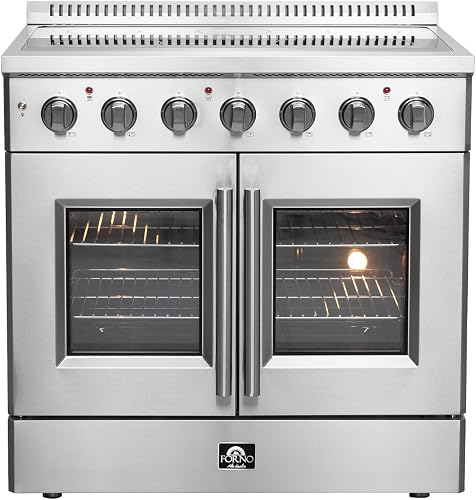
Gas ranges require an active natural gas line or a liquid propane hookup, plus a standard 120-volt outlet for the igniter and clock. If your kitchen already has both, the installation swap is straightforward. Induction ranges run on 240-volt circuits, the same service that most electric ranges use. If you currently have a gas range and want to switch to induction, an electrician will need to run a 240-volt line to your range location, which can add several hundred dollars to the project cost. On the product side, the Forno C-FFSEL6917 is a 36-inch induction range with a 4.32 cubic foot oven and 5 elements at around $2,699, while a 30-inch gas option like the GE JGBS30DEKBB offers a 4.8 cubic foot oven for roughly $758, which illustrates the typical price gap between the two technologies.
Precision, Simmer Control, and Day-to-Day Cooking
Induction wins on precision because the magnetic field responds almost instantly to dial adjustments, and the heat is measured in watts rather than inferred from a flame you are eyeballing. Holding a true, low simmer for a beurre blanc or a delicate chocolate sauce is easier on induction because there is no residual heat from a burner grate to fight. Gas has its own advantage for high-heat tasks like stir-frying in a traditional round-bottom wok, where cooks want the flame to lick up the sides of the pan. A flat induction element cannot replicate that geometry, though a flat-bottom induction-compatible skillet handles most high-heat searing without issue.
Safety, Ventilation, and Air Quality
Induction has a clear safety edge because the cooktop surface only gets warm from contact with a hot pan, not from a heat source of its own. Spills do not bake on, and there is no open flame to ignite a dish towel. Gas combustion releases nitrogen dioxide and carbon monoxide into the kitchen air, which is why ventilation matters more with a gas range. If your kitchen has a ducted range hood rated for the BTU output of your gas burners, this is manageable. Without adequate ventilation, indoor air quality researchers have documented elevated pollutant levels above gas ranges during cooking. Neither range type eliminates the need for good kitchen ventilation, but gas amplifies it.
Which Range to Choose Based on Your Situation
Choose gas if you have an existing gas line, cook frequently with a wok or carbon steel pans, and want to keep the purchase price low. The GE JGBS30DEKBB is a 30-inch freestanding gas range with a 4.8 cubic foot oven, sealed burners, and knob controls at around $758. The Samsung NX60A6511SS steps up to a 6.0 cubic foot oven with 5 sealed burners for around $849 if you need more capacity. Choose induction if you are remodeling, willing to run a 240-volt circuit, and want faster boil times, a cooler cooking surface, and easier cleanup. The Forno C-FFSEL6917 36-inch induction range delivers 5 elements and a 4.32 cubic foot oven at around $2,699 for cooks who want the full induction experience in a pro-style body.
Common mistakes to avoid
- Assuming induction will work with your current cookware without testing each piece with a magnet first
- Forgetting to budget for a 240-volt circuit installation when switching from gas to induction
- Buying a gas range without confirming the kitchen has adequate ducted ventilation to handle combustion byproducts
- Choosing a range based on oven capacity alone without checking whether the burner count and layout match how you actually cook
- Overlooking sealed-burner gas designs, which are much easier to clean than open-burner grates
- Dismissing induction solely on price without accounting for faster cook times and lower long-term energy costs compared to gas
Frequently asked questions
Is induction cooking faster than gas?
Yes, induction boils water faster than gas in back-to-back comparisons because it transfers energy directly to the pan rather than heating the air between a flame and the pot. The efficiency advantage is real, but for most everyday cooking tasks the difference in speed is a matter of a few minutes rather than something you will notice on every meal. Where induction pulls further ahead is in instant response to dial changes, especially when you need to drop from a rolling boil to a gentle simmer quickly.
Do I need to replace all my pots and pans to use an induction range?
Not necessarily. Cast iron and most stainless steel pans work on induction without any changes. The easiest way to check is to press a refrigerator magnet firmly to the bottom of each pan. If it holds well, the pan is induction-compatible. If it falls off or barely sticks, that piece will not heat on induction. Most cooks find they need to replace only one or two pieces, typically thin aluminum or copper pots.
Can I still cook during a power outage with an induction range?
No. Induction ranges require electricity to operate, so a power outage leaves you without a cooktop. A gas range with an electric igniter can still be lit manually with a match during an outage, making it the more resilient option for households in areas with frequent power interruptions. If backup cooking capability matters to you, gas or a separate camp stove is the practical choice.
Are gas ranges being banned?
Some cities and states have adopted building codes that restrict new natural gas hookups in new residential construction, but existing gas ranges in existing homes are not being banned anywhere in the US as of mid-2026. The regulatory landscape varies significantly by location, so check your local building department if you are building a new home or undertaking a major kitchen remodel. For an existing kitchen with a working gas line, replacing a gas range with another gas range remains straightforward in virtually every jurisdiction.
Which is cheaper to run, induction or gas?
Induction converts roughly 85 to 90 percent of its electrical energy into heat in the pan, versus about 40 percent for gas, so it uses less energy per cooking task. Whether that translates to lower monthly bills depends on your local electricity and natural gas rates, which vary widely. In many parts of the US, natural gas is still cheaper per BTU than electricity, so even though gas wastes more energy, the lower fuel cost can offset the efficiency gap. Run the math using your actual utility rates rather than assuming one is cheaper.